Back to works · Back to research · All projects
Dance / Music / Neuroart
Free Rein
Dance, live music, and an EEG-modulated visual score · 2026
Free Rein is a collaboration with NobleMotion Dance and Musiqa that brings live music, dance, and mobile brain imaging into a shared theatrical work. Five dancers and four musicians move between scripted material and improvisation, while projected imagery responds to selected EEG signals from two of the dancers. The performance itself becomes a setting for studying creative decisions as they unfold.
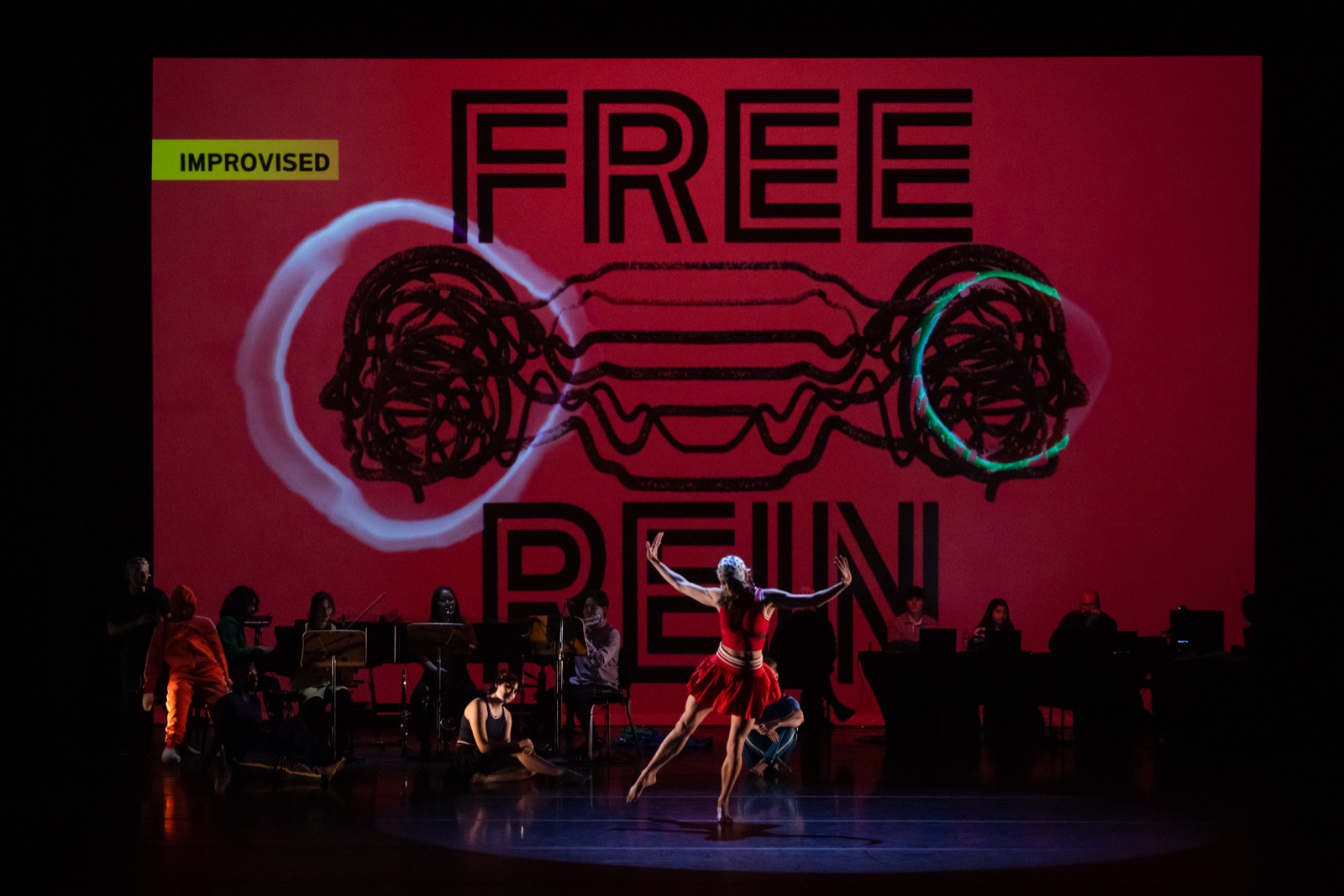
A real-time visual score
I designed the projections as a real-time visual score, connecting the brain data being recorded with the work’s music, movement, and stage action. Two stylized head forms correspond to the dancers wearing EEG caps. Their colors relate to the dancers’ costumes, giving audiences a clear way to follow each person’s visual presence. Each data stream is calibrated and mapped separately.
Selected EEG-derived values shape the movement of halos, brightness, scale, turbulence, particles, and fluid motion. Across the first six movements, three visual states follow the paired scripted and improvised sections: a divided field for two performers, a shared space with distinct halo colors, and a particle environment in which the words Free Rein emerge from the head forms. These states return in the finale, carrying the visual history of the piece into its most open passages.
The system combines TouchDesigner’s generative imagery with a custom Max/MSP interface coordinating playback, the musicians’ click track, hall audio, and visual scene changes. Processed EEG arrives from the neuroengineering computers over wired Ethernet. During the introduction, each dancer’s incoming values are calibrated; scaling and smoothing then make changes legible at the scale of the stage. Composed cues organize the larger form while live data continually changes the image.
Constraint, play, and improvisation
Anthony Brandt’s score pairs fully notated music with improvisations guided by pitch fields and recorded tracks. The ensemble comprises flute and alto flute, clarinet and bass clarinet, violin, and piano. Andy and Dionne Noble’s choreography follows the same transitions between fixed and improvised material, using games and recurring objects—a bungee cord, a ball, and a book—to make changing rules and choices visible.
As the seven-movement work progresses, performers gain greater freedom to respond to one another. A life-size puppet provides a theatrical thread, and the finale opens into a seventy-second passage in which the musical score is left blank. The structure creates space for spontaneous interaction while giving both audiences and researchers recognizable points of comparison.
Research within live performance
The study uses repeated performances to compare each participant’s neural activity across scripted and improvised passages, different days, and performance settings. Wireless 32-channel EEG recorded the same two dancers throughout the January performances, alongside recordings from musicians and, in selected shows, the composer. Clearly differentiated sections and synchronized playback support comparison across performances while preserving the demands of a live theatrical event.
The projections are artistic translations of selected EEG measurements, not validated measures of creativity or synchrony between the dancers’ brains. Movement-related signal artifacts and the small participant group remain important limits. The accompanying paper documents the study’s design and reports that scientific analysis was ongoing at the time of writing.
Collaboration and performers
Music: Anthony Brandt · Choreography: Andy and Dionne Noble, NobleMotion Dance · Real-time visualization and performance systems: Badie Khaleghian
Research collaborators: Andrew D. Nordin, University of Houston, and Anna Abraham, University of Georgia. The collaboration brings together NobleMotion Dance, Musiqa, Rice University, Sam Houston State University, the University of Houston, the University of Georgia, and Bowdoin College.
NobleMotion dancers: Deontay Gray, Reese Meredith, Tyler Orcutt, Jacob Regan, and Lauren Serrano.
Musiqa musicians: Garrett Hudson, flute; Maiko Sasaki, clarinet; Nanki Chugh, violin; Chelsea DeSouza, piano.
Performances
January 20–22, 2026 · The Hobby Center for the Performing Arts, Houston · Six Discovery Series performances for 2,358 fifth-grade students, teachers, and chaperones.
January 23–24, 2026 · Midtown Arts and Theater Center Houston (MATCH) · Two public performances. The eight January performances reached nearly 2,600 students and adults.
March 2026 · Rice University · Houston, Texas.
Related research paper
Free Rein: Designing a Real-World Neuroscientific Study of Creativity
Anthony Brandt, Andrew Noble, Dionne Sparkmann Noble, Badie Khaleghian, Andrew D. Nordin, and Anna Abraham.